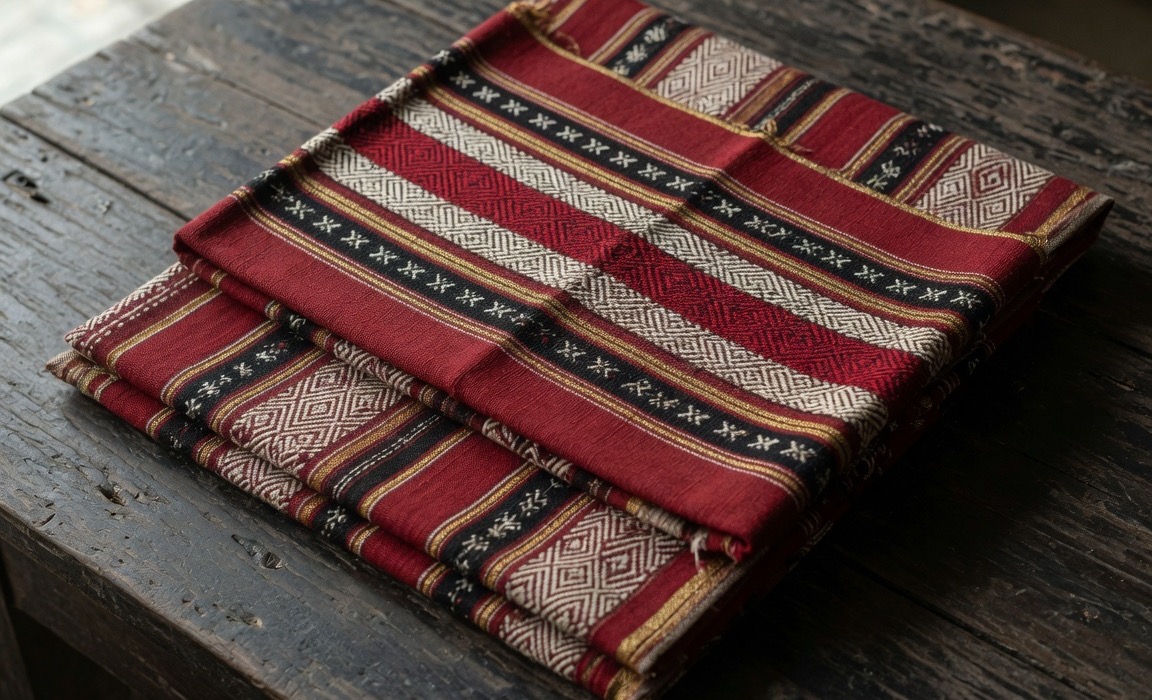
What visitors notice first is often the cloth: crimson, black, ivory, a thread of gold, geometric bands from a backstrap loom. The houses come next. Under those roofs people speak S’gaw and Pwo, farm rice, fish the river, and keep a land system older than the modern state.
Vernacular architecture
Karen highland houses are raised. Posts of teak or other timber lift the living floor above flood, livestock, snakes and the wet-season ground. A ladder is the door. The undercroft is working space: storage, looms, firewood, animals, children in the dry dust. Walls are split bamboo, woven and replaced when they fail. Roofs were thatch of leaf or palm. Corrugated iron is now common on this river, as the village photograph on the home page shows. The change is climate, trade and war, not a loss of the type. The type is the raised frame, the ladder, the gable, the forest at the eaves.
On the Thai side of the hills a traditional house is sometimes called she: stilts about two metres, umbrella-palm thatch, walls renewed every few years. That is published village-revitalisation work in the Kaeng Krachan forests, not a measured survey of Mu Aye Pu. A S’gaw or Pwo name for these houses belongs to the people who live in them. The photographs of this landing show the same grammar of building: timber, bamboo, a dirt street, smoke in the evening.
The house is climate knowledge. Air moves under the floor. Rain sheds. The slope is not cut into a pad if the posts can take it. Repair is local: bamboo, thatch, a new ladder. A guest who is asked to leave shoes, or not to photograph a hearth, is in someone’s architecture, not a lodge set. A later planning word, Rubanisation, imagined rural and urban as one. The houses here were already that mix. The township drawings were not.

Kaw
Kaw is at once a place, a land unit and a social system: rotational ku fields, hunting taboos, sacred forest, graveyards, umbilical-cord trees, village meetings beside hereditary spiritual authority. It is how many Karen communities hold country. It is not a museum label, and not an amenity for a lodge.
Whether Mu Aye Pu village itself is organised as a kaw is a question for its people. That answer is theirs.
Faith and language
Baptist churches, Buddhist monasteries and older spirit practice stand in the same landscape, sometimes in the same family. English-language writing has often flattened that into a single “Karen” picture. The picture is plural.
S’gaw and Pwo are Karen languages. They are not dialects of Burmese. Roman and Karen scripts are both used. A public website in English is already a translation; it should not pretend to be the village’s own voice.
Making
Weaving, blacksmithing, bamboo work, boats, and the poetry called loola hta belong to this culture. In Mutraw District the Tha Nue Chet La cultural school has been part of the Salween Peace Park’s work of keeping those arts alive. They are living arts, not a display. A guest who is shown a loom is being trusted.